|
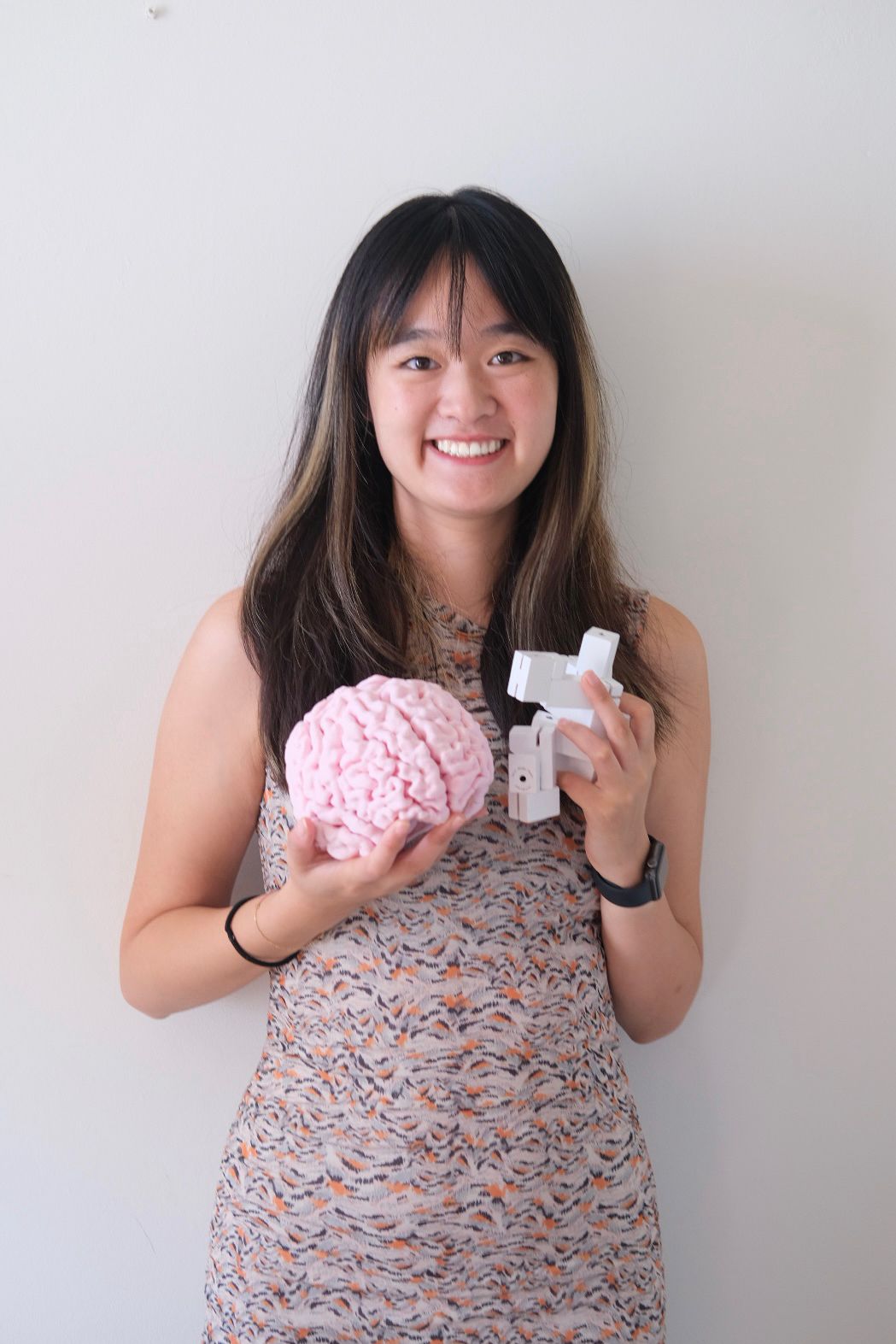
Dota - Tianai DongHi! I am a fourth-year (and final-year) PhD student, affiliated with Multimodal Language Department at the Max Planck Institute for Psycholinguistics, and Predictive Brain Lab at the Donders Institute (Centre for Cognitive Neuroimaging). I am funded by an IMPRS fellowship in Language Science. My work focuses on understanding language and its interaction with the physical and social world. I take an interdisciplinary approach, combining computational methods —such as machine learning and bayesian modeling— with insights from neuroscience, linguistics, and psychology to better understand the human mind and advance artificial intelligence.
Fun Fact: Dota is actually my real, preferred name. It comes from my Mandarin initials, no connection to the game;). My family started calling me that, my friends picked it up, and it’s stuck ever since (in the best way).
If you’d like to discuss academic topics, feel free to get in touch :).
|
|
|
|
|
2026 Aug
🎤 Had such a lovely time at CCN 2026! I gave a lightning talk at the satellite event Beyond Curated Datasets: Learning Representations from Children's Everyday Experiences, presented our poster Do Multimodal Language Models Track Minds and Space?, and helped put together the DEI program with the wonderful DEI committee. So many good conversations about science, life, and everything in between with old and new friends 💛 2026 Jul
🎉 Using Perspectival Words Is Harder Than Vocabulary Words for Humans —and Even More So for Multimodal Language Models was accepted as a main paper at ACL 2026, and I had a wonderful time presenting it in San Diego! I also visited UT Austin, where I gave talks at the Developing Intelligence Lab and KOALAB. Many lovely conversations, world cups, bbqs, and wonderful people along the way :) 2026 May
🧠💭🤖 The very popular Workshop on Representational Alignment is back at ICLR 2026 in Rio! |
|
|
|
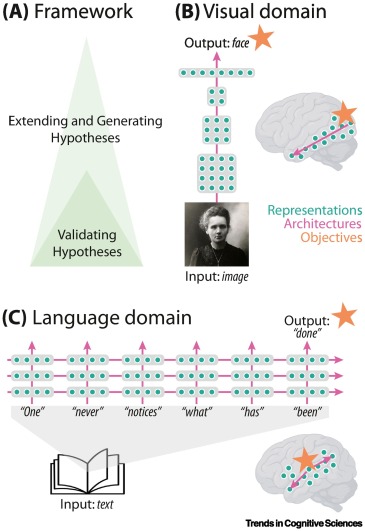
Lea-Maria Schmitt*, Dota Tianai Dong*, Emin Celik*, Floris P. de Lange, Mariya Toneva Trends in Cognitive Sciences. paper Over the past decade, comparisons between deep neural networks (DNNs) and the human brain have become central to cognitive neuroscience. Early work focused on vision, driven by the success of convolutional neural networks in object recognition, before such comparisons later gained traction in language with the rise of large-scale language models. These comparisons have validated existing hypotheses and generated new ones, challenging views of information processing, connectivity, and computational goals. Despite progress, debates persist over the interpretability and validity of mapping DNNs to brains, underscoring the need for more refined models and methods. Looking ahead, integrating cross-modal insights from vision and language, together with improved modeling and experimental frameworks, promises to advance the mechanistic understanding of cognition. |
|
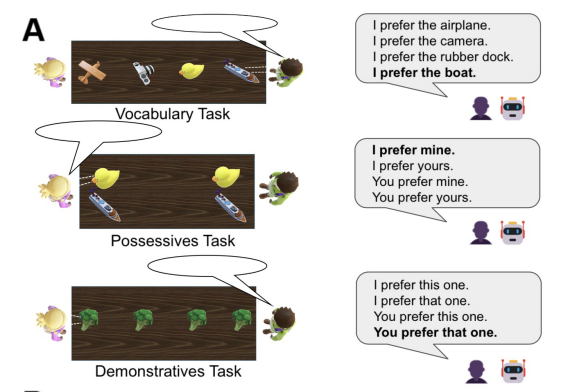
Dota Tianai Dong*, Yifan Luo*, Po-Ya Angela Wang, Asli Ozyurek, Paula Rubio-Fernandez In Proceedings of the 64th Annual Meeting of the Association for Computational Linguistics (ACL). Association for Computational Linguistics. ACL oral presentation (<5% of submissions). paper Multimodal language models (MLMs) increasingly demonstrate human-like communication, yet their use of everyday perspectival words remains poorly understood. To address this gap, we compare humans and MLMs in their use of three word types, which we predict impose increasing cognitive demands: vocabulary (e.g., 'boat' or 'cup'), possessives (e.g., 'mine' vs. 'yours'), and demonstratives (e.g., 'this one' vs. 'that one'). Testing seven MLMs against human participants, we find that perspectival words are harder than vocabulary words for both groups. The gap is even larger for MLMs: while models approach human-level performance on using vocabulary, they exhibit clear deficits with possessives and even greater difficulties with demonstratives. Ablation analyses point to limitations in perspective-taking and spatial reasoning as key sources of these gaps in MLMs. Instruction-based prompting helps close the gap for possessives but still leaves demonstratives far below human performance. These results show that, unlike vocabulary, perspectival words pose a greater challenge in human communication—and this difficulty is further amplified in MLMs, revealing a crucial shortfall in their pragmatic and social-cognitive abilities. |
| For a complete list, see my Research page → | |
|
|
For all activities, see my Community page → |
|
© Copyright 2026 Dota Dong. Last updated July, 2026.
|